10 Practical Tips for a Stress-Free Trip to Germany
A visit to the North Rhine-Westphalia (NRW) region and the Ruhr area is popular because of the short travel time from the Netherlands, but the rules there are slightly different from those at home.
Here's a handy overview with 10 practical tips for a worry-free trip to Germany, starting with the most important one:
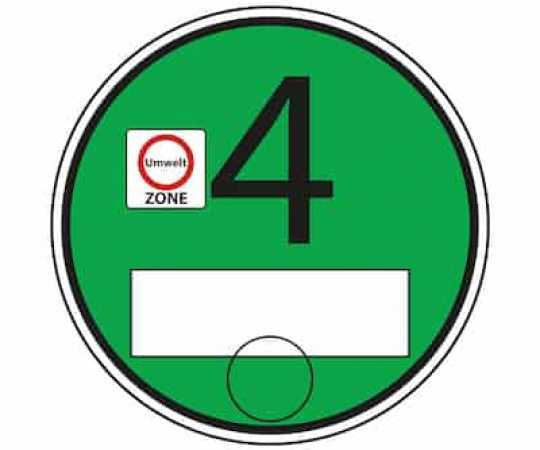
1. The German Environmental Sticker (Umweltplakette)
What it is: Many cities in the Ruhr region (such as Essen, Dortmund, Düsseldorf, Cologne, and Gelsenkirchen) have an Umweltzone. You may only drive into these cities if your car has a green environmental sticker.
Where to buy: Order it in advance online through official channels such as the ANWB, TÜV or Dekra. Make sure to do this in advance (allow for a few days to a week for shipping). It’s best to avoid buying it from shady, overpriced websites that charge extra administrative fees.
Fine: If you drive into an environmental zone without a sticker (or with an expired yellow/red sticker), you risk a fine of €100.
Please note: You do not need a sticker on the highways through or past cities; however, once you take the exit and drive into the city, the sticker is required.
2. Required Car Items in Germany
In addition to your warning triangle and a set of safety vests (required for each passenger in some situations; at least one is required in any case), make sure you also have an approved first-aid kit in your car. It must comply with the DIN 13164 standard and must not have expired. Check this in advance!
3. Speed and the "Driving Ban" for driving on the left
On the German Autobahn, there is no general speed limit in many places (there is often a recommended speed of 130 km/h, the “Richtgeschwindigkeit”), but speed limits are being introduced on an increasing number of stretches (pay close attention to the signs).
Do not linger unnecessarily in the left or middle lanes; passing on the right is strictly prohibited and is severely penalized.
4. Cash Is Still King (Nur Bar)
Although you can use a debit card in more and more places in cities, Germany is much more conservative when it comes to payments than the Netherlands. Always bring enough cash in euros. In many bakeries, small cafés, parking meters, and traditional Biergärten, you still can’t pay with a debit or credit card—or can only do so if your purchase exceeds a certain amount.
5. Parking and the Parkscheibe (parking disc)
If you come across a blue zone or a parking space with a sign showing a parking disc, make sure you have a European blue parking disc clearly visible behind the windshield.
Important detail: Always set the dial to the next full hour or half-hour after you arrive. (If you arrive at 2:15 p.m., set the dial to 2:30 p.m.). If you forget to do this, you’ll quickly get a ticket.
6. Traveling by Train with the Deutschlandticket
Would you rather explore the Ruhr region by train? Then the Deutschlandticket (D-Ticket) is highly recommended. For a fixed monthly fee, you can travel unlimited throughout Germany on all local buses, trams, subways, and regional trains (RE and RB). It’s ideal for day trips between cities such as Düsseldorf, Duisburg, Essen, and Dortmund.
7. Stores are closed on Sundays (Ladenschluss)
In Germany, stores are often closed on Sundays. This means you can only do your grocery shopping on Sundays at locations with a special exemption, such as major train stations (for example, Düsseldorf Hauptbahnhof or Cologne). So plan your weekend grocery shopping or souvenir shopping for Saturday! Occasionally, there are Sundays when stores are open for business. An up-to-date list of these can be found on this website: Sunday Shopping Overview.
8. Bottle and can deposits (Pfand)
Don't just throw away plastic bottles and beverage cans. In Germany, almost every plastic bottle and can has a deposit (Pfand), usually between €0.08 and €0.25. You can return them to a deposit machine (Pfandautomat) at any supermarket in exchange for a receipt that you can redeem or apply toward your purchase at the register.
9. Bicycle-Friendliness and the Radschnellweg (RS1)
The Ruhr region has undergone a tremendous transformation when it comes to cycling. For example, there’s the RS1 (Radschnellweg Ruhr), a wide bike highway that connects former railroad lines. It’s fantastic to rent an e-bike for a day and explore the industrial heritage (such as the Zollverein UNESCO World Heritage Site) along routes like this.
10. Dashcams: Be Aware of Privacy Rules
Using a dashcam in a car is permitted in Germany, but privacy laws (GDPR) are very strict. You are not allowed to continuously record footage or publish it on social media or YouTube without permission (unless you completely blur all license plates and faces so they are unrecognizable). Many dashcams have a “loop function” that only records the last few minutes in the event of an incident; this is generally acceptable as evidence.